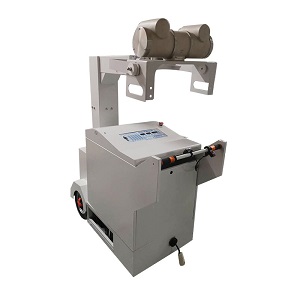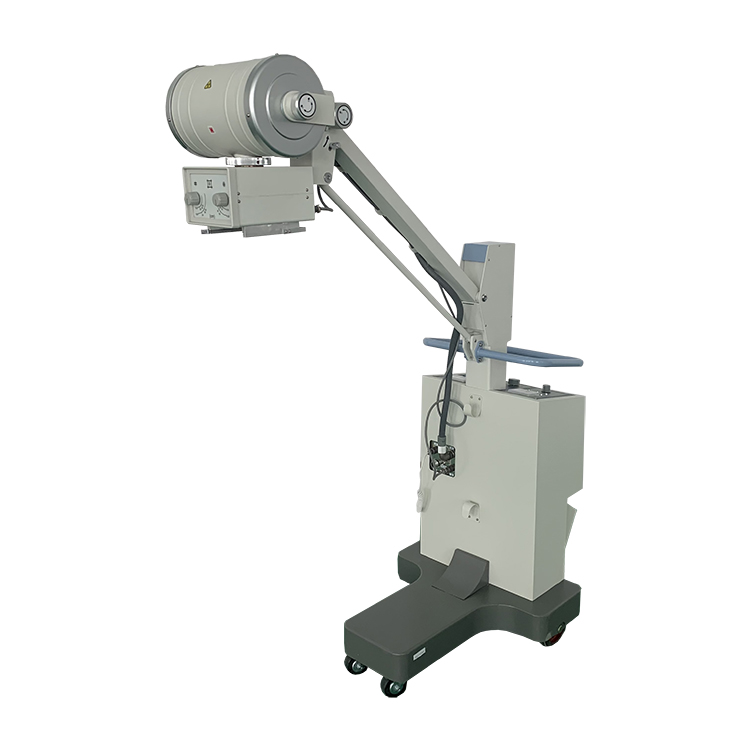
Choosing between a mobile X-ray machine and a portable X-ray machine is one of the most common decisions clinics face when upgrading their radiography capability. Both fall under the “moving X-ray to the patient” category, but they are built for very different workloads, budgets, and departments. Pick the wrong one and you either overspend on capacity you never use — or bottleneck your daily patient flow with a machine that wasn’t designed for the job.
This guide breaks the decision down into the four dimensions that actually matter: power, mobility, applicable departments, and typical procurement budget — using real specifications from Newheek’s product line as reference points.
Power determines what anatomy you can image well.
Portable units in Newheek’s lineup, such as the NK100DT (5 kW), deliver:
That is more than enough for extremities, pediatric imaging, small animals, and chest work at the bedside. It is not the tool for heavy adult pelvis or lumbar spine studies.
Mobile DR systems, like Newheek’s 400 mA mobile medical DR, are built for the heavy end:
Rule of thumb: if your exam list is mostly limbs, chest at the bedside, and children, 5 kW is plenty. If you image chest, pelvis, and lumbar spine on adults routinely, you want the mobile DR class.
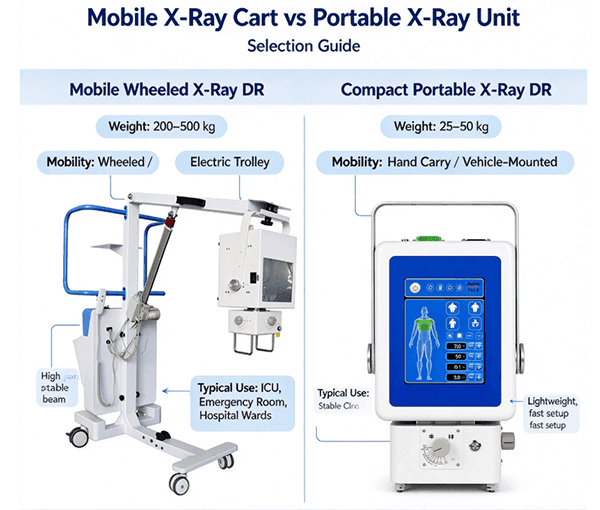
Portable wins on raw portability. The NK100DT weighs just 15 kg (265×240×210 mm), needs no lead-shielded darkroom, and offers three exposure modes — remote control, hand switch, and touchscreen. With the optional mobile rack it doubles as a bedside unit. It fits in a car trunk, which is why it dominates in home visits, ambulances, disaster response, and field screening.
Mobile DR wins on departmental workflow. Power-assisted forward/backward movement, an auto-retracting power cable that prevents winding, and a wireless detector mean one technologist can roll it ward-to-ward and shoot without unplugging everything. For a hospital running 30+ mobile studies a day, that ergonomics gap compounds fast.
In short: portable = carried to the patient anywhere; mobile = rolled to the patient efficiently, all day.
| Department / Scenario | Better Fit |
| Outpatient orthopedics, fracture triage | Portable |
| Pediatrics / neonatal | Portable |
| ICU / ward bedside imaging (chest) | Mobile DR (portable viable for light load) |
| Chest, pelvis, lumbar spine screening | Mobile DR |
| Ambulance, disaster relief, field screening | Portable |
| Veterinary clinics (cats, dogs) | Portable |
| Physical examination centers (high volume) | Mobile DR |
| Rural clinics with no shielding room | Portable |
Budgets differ by roughly an order of magnitude, so this is often the deciding factor.
Portable X-ray machine: A 5 kW portable such as Newheek’s NK-DT5/NK100DT class typically lands around US$25,000–35,000. Add the DR flat panel detector separately if you want a digital portable DR system.
Mobile X-ray machine (mobile DR): A 400 mA-class mobile DR with a 14″×17″ wireless detector is a quote-based purchase, typically in the US$15,000–30,000 range depending on detector brand, generator class, and shipping configuration.
Also budget for the hidden line items: lead aprons and shielding assessment, installation and commissioning, local regulatory registration, and — for mobile DR — a service plan. Newheek ships FOB from Qingdao/Ningbo/Shanghai with a one-year free warranty from commissioning, and most products carry CE certification.
Choose portable if: your clinic is small or new, your caseload is extremities + light chest work, you need imaging in multiple locations or off-site, and capital budget is tight.
Choose mobile DR if: you run daily bedside lists across wards, you image adult chest/pelvis/lumbar spine, you need digital workflow (PACS/DICOM) at volume, and downtime during power issues is unacceptable.
Many hospitals buy both: one mobile DR for in-ward coverage and one portable for ER overflow, field screening, and veterinary or pediatric work.
Tell us your scenario and our engineers will recommend the right configuration — with a formal quotation — within 24 hours.
Mobile DR X-ray Machine
Hot Line: +86 19015366638
Whatsapp:+86 19015366638
Email: newheekcn@163.com
Company: Weifang Newheek Electronic Tech Co., Ltd.
Add: E Building of Future Star Scientific Innovation Industrial Zone of No.957 Wolong East Street, Yulong Community, Xincheng Sub-District Office, Weifang Hi-tech Zone, Shandong Province, China