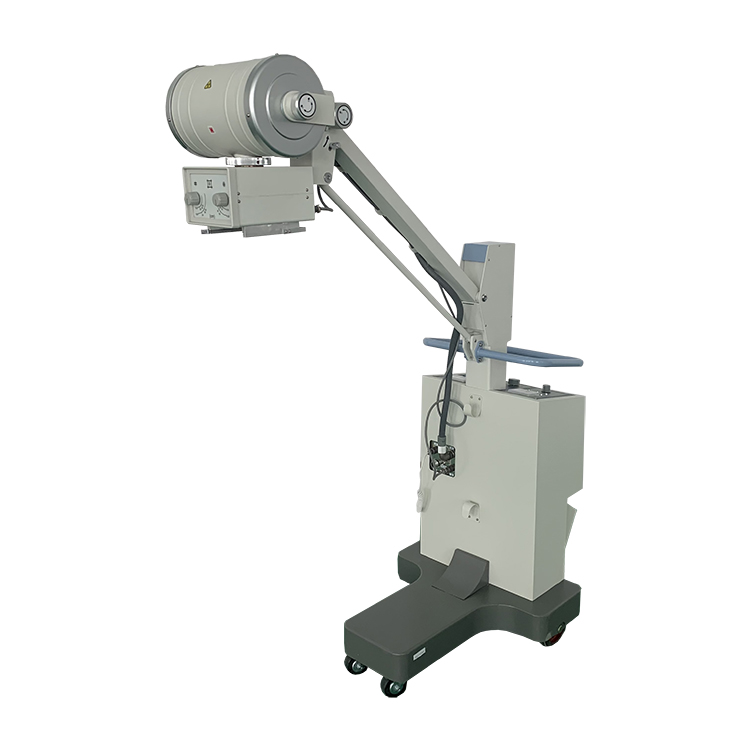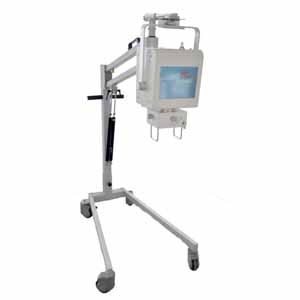
A fixed radiography room cannot follow an ambulance, and it cannot reach a village clinic. When a patient cannot be moved, the only useful X-ray machine is the one that can be carried to them. That is the problem the Newheek NKY100 portable X-ray machine was built around: a 100 mA high-frequency unit with an X-ray head of roughly 15 kg, a standard 220 V wall socket, and optional DR flat panel detection. No lead-shielded darkroom, no three-phase power upgrade, no room to rebuild.
Why emergency teams and outreach clinics buy portable X-ray
In pre-hospital care, the first question after a trauma call is whether there is a fracture or a chest injury that changes the transfer plan. A fixed unit cannot answer that question at the scene. In rural outreach, the constraint is different but just as practical: patients cannot travel to an imaging room that may be hours away, and a mobile screening van has no space for a full radiography suite.
A portable X-ray machine solves both by moving the imaging to the patient. For ambulance services, that means the unit rides in the vehicle and is ready at the roadside. For outreach teams, it means an operator can carry the head into a village room, set up a flat panel detector, and produce a digital image within minutes. The value is not simply “smaller equipment” — it is a different care pathway, one where imaging happens before the patient is moved rather than after.
That shift is why the 100 mA class has become the default choice for mobile work. It is powerful enough for extremities and chest radiography, yet light enough to be handled by one person and powered by an ordinary socket.
NKY100 specifications at a glance
| Parameter | NKY100 |
| Output power | 5 kW (5.3 kW max) |
| Tube voltage | 40–110 kV (up to 125 kV on selected builds) |
| Tube current | 100 / 80 / 63 / 50 / 32 mA |
| mAs range | 0.32–315 mAs |
| Exposure time | 0.01–6.3 s |
| Focal spot | 0.6 / 1.8 mm (small / large) |
| Total filtration | ≥ 2.5 mm Al equivalent |
| Power supply | 220 V ±10%, 50 Hz ±1 Hz, single phase |
| X-ray head weight | approx. 15 kg (full unit approx. 21 kg) |
| Dimensions | 370 × 260 × 230 mm |
| Imaging area | Human limbs and chest |
| Detector pairing | NK4343S wired / NK4343W wireless, 430 × 430 mm
|
What “one-person carry” really means
A light machine is only portable if the whole workflow is light. The NKY100 keeps the X-ray head around 15 kg, with the complete unit at roughly 21 kg, so one adult can lift it from a vehicle and set it up without a trolley. A water-resistant, shock-absorbing case protects it during transport over rough roads, and an optional mobile frame turns the same unit into a bedside system when it is used inside a ward.
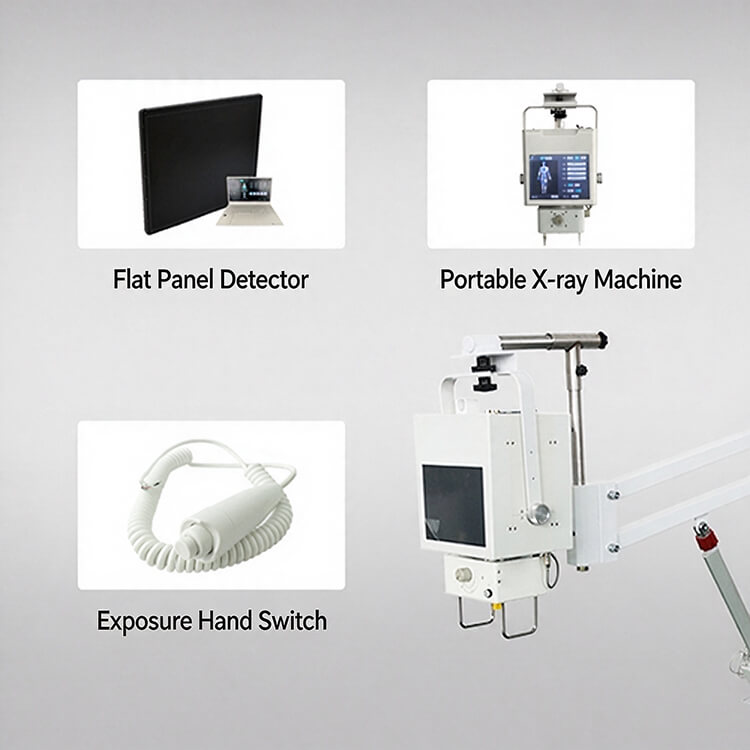
Three exposure control modes — wireless remote, hand switch, and touch screen — let the operator step back from the beam during exposure. Fault self-diagnosis and built-in protection against over-voltage, over-current, and overheating make field troubleshooting straightforward when there is no service engineer on site. High-frequency inverter technology keeps the high-voltage output stable, which reduces artifacts and repeat shots.
The electrical requirement is the quiet advantage. A single-phase 220 V supply means no three-phase upgrade, no new distribution board, and no electrician quote that exceeds the price of the machine. For rented clinic space and screening vehicles, that often decides the purchase.
Four scenarios where it earns its keep
– Ambulance and emergency response. Carry it to the patient, image extremities and chest at the scene, and give the receiving hospital a working diagnosis before transport.
– Rural and outreach screening. Pair the unit with the NK4343W wireless flat panel for chest and limb surveys in village clinics, with DICOM output for archiving and remote reporting.
– Small clinics and bedside radiography. Add the mobile frame or a flat radiography table to image patients who cannot stand or travel to a radiology department.
– Veterinary practice. The same generator supports companion animal DR for limb and chest examinations, making it a flexible asset for mixed practices.
FAQ:
Do I need a lead-lined room or three-phase power?
No. The unit runs on a standard single-phase 220 V circuit and has total filtration of at least 2.5 mm Al equivalent with beam limitation. Standard radiation protection — lead apron, thyroid shield, and a mobile lead screen — is still required at the scene.
Can it be used as a full DR system?
Yes. The NK4343S wired or NK4343W wireless flat panel detector provides a 430 × 430 mm imaging area. Images can be windowed, annotated, and stored on a connected workstation.
Which examinations is it suited to?
Extremities, joints, and chest imaging in small to medium-sized patients. The 0.32–315 mAs range gives useful flexibility in this power class.
When should I choose a larger machine instead?
If a significant share of your patients are over roughly 80 kg, or you routinely need lateral lumbar spine or full-abdominal views, step up to a 300 mA or 500 mA system. The NKY100 is optimized for mobility, not high-volume general radiography.
Wired or wireless detector?
Wired panels cost less and suit a fixed outreach station. Wireless panels are faster to position and are the better choice when the detector must move around a patient in confined spaces.
What about price and lead time?
Configuration drives the quote. Tell us your panel type, whether you need the mobile frame, and your expected daily exposures, and we will send a written configuration list and delivery schedule.
WhatsApp:+8619015366638
Email:newheekcn@163.com